



Picture the scene: an international conference, 400 attendees, speakers from around the world. The content is excellent. But after 45 minutes, people start shifting in their seats, standing up to stretch their legs, and checking their phones. Not because they’re bored, but because the chairs are hurting their backs.
Event organisers know this scenario all too well. And it happens far more often than you might think, even in institutions that have invested millions in audiovisual systems, staging, or architecture. The furniture, meanwhile, was treated as a budget item to cut.
That’s a mistake. Auditorium furniture is the first physical point of contact with the space. It’s what attendees experience for hours at a time. It shapes their concentration, their comfort, and their overall impression of the event’s quality.
A poorly equipped auditorium is like a fine dining restaurant with cafeteria chairs. The overall experience simply doesn’t work.
An auditorium seat has very little in common with an office chair, a cinema seat or a stadium fold-down seat. It is a category of furniture in its own right, designed to meet highly specific requirements and demanding specialist expertise.
In a university lecture theatre, the same seat may be used by hundreds of students over the course of a single day. In a conference hall, delegates may remain seated for six hours at a stretch. In a corporate auditorium, the room might be used only twice a month, but for very different types of events: plenary sessions, training seminars and cultural performances.
These intensive and varied uses create demands that residential or office furniture simply cannot meet. Frames need to withstand thousands of cycles of use. Upholstery must cope with frequent cleaning. Fixing systems have to remain stable under repeated mechanical stress.
The seat is the centrepiece. And as with so many things, the difference between a seat no one notices and one people remember for all the wrong reasons comes down to the details.
This is the benchmark solution for permanent venues. The seat automatically folds up when the user stands, which is essential in tiered layouts where space between rows is limited.
That automatic tip-up mechanism may sound like a small detail. It is anything but. In a 600-seat auditorium, if 50 people stand up during the interval and the seats stay down, the aisles can become difficult to navigate within seconds.
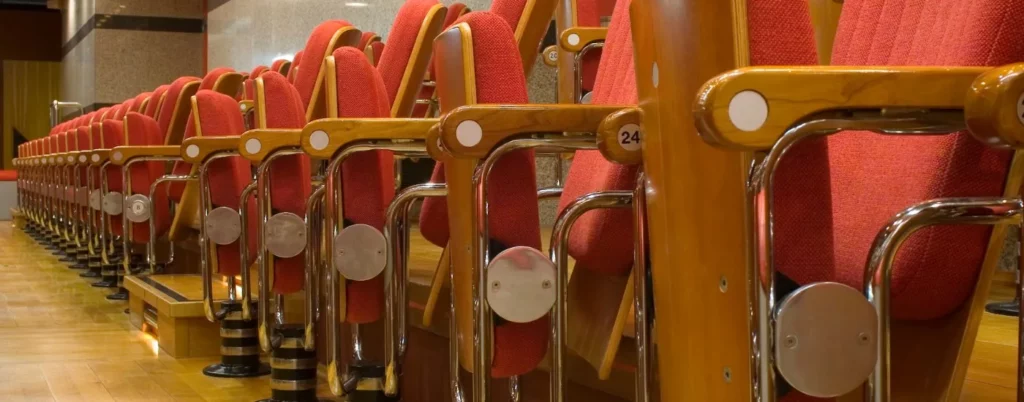
A good fixed seat should also have a silent return mechanism. In a conference hall where a speaker is presenting in a low voice, that kind of detail makes a real difference.
Another point that is often overlooked is the actual width of the seat. There can be a considerable gap between the “55 cm” stated on the technical specification sheet and the space genuinely available once the armrests are in place. It is always better to ask for the internal seat width rather than the overall dimensions.
For venues with a variable layout, spaces that are regularly cleared and reconfigured depending on the event, stacking chairs are indispensable. They need to be lightweight, ideally under 5 kg, durable, and able to stack high without becoming unstable. Transport trolleys with castors are almost essential in venues where furniture has to be moved frequently and in large quantities.
A foldaway writing tablet built into the armrest has become standard on many mid-range and premium models. It is particularly useful for training sessions, interactive conferences and workshops. Some models even include a discreet USB port, which is a genuine advantage for attendees working on laptops throughout the day.
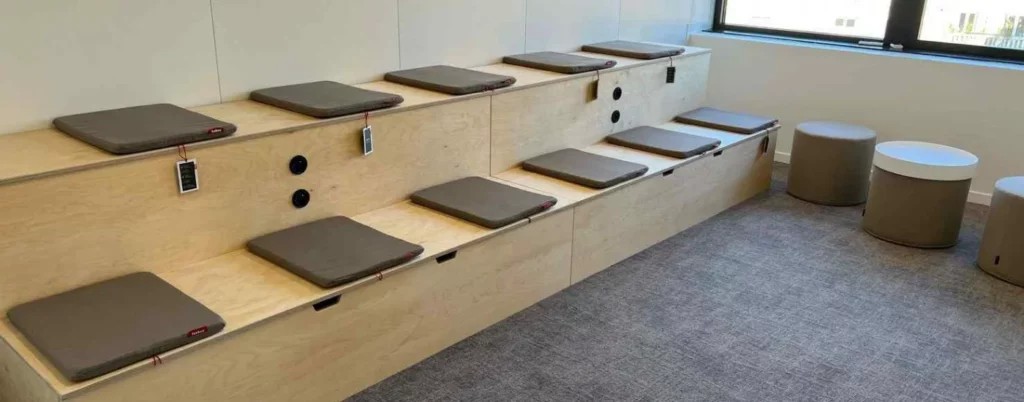
Already have concrete tiered seating in place? There is no need to rip everything out. High-density polyurethane seat pads, either fixed in place or simply laid on the steps, can improve comfort dramatically without major building work. It is a cost-effective solution, quick to install and easy to replace. It is widely used in the refurbishment of older lecture theatres and sports venues converted for other uses.
This is often the forgotten element in auditorium fit-out projects. People think about the seating, the stage and the screen. Then, often too late, they realise that attendees have nowhere to put a laptop, their notes or even a cup of coffee.
And yet workspace is a fundamental consideration as soon as the auditorium is used for anything other than passive viewing. A participatory conference, a training session, an annual general meeting: in all of these settings, attendees need somewhere to write, consult documents and take notes in real time.
There are several ways to meet that need. The most basic is the writing tablet built into the armrest. Foldaway and discreet, it disappears when not in use and provides a surface of around 30 x 25 cm when opened. That is enough for a notepad, and just about workable for a compact laptop. The better-designed models include a one-handed opening mechanism and a non-slip lip along the edge.
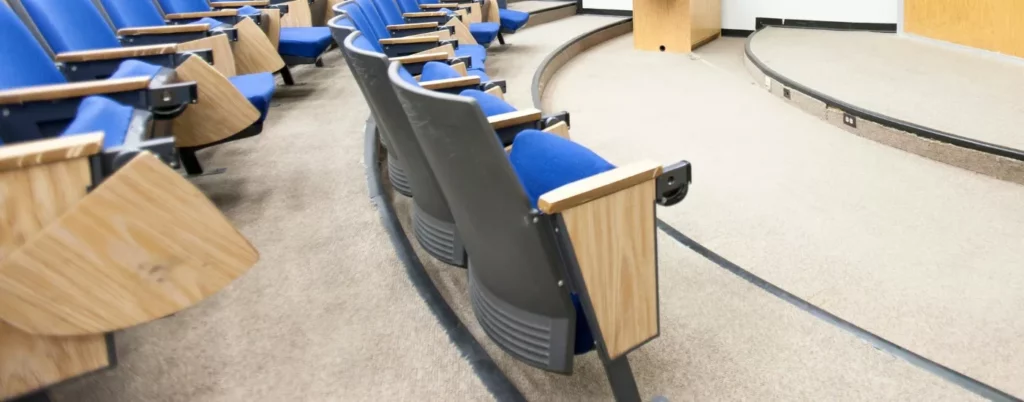
A more advanced option is the continuous row-mounted writing tablet fixed to the back of the seat in front. Think of an airline tray table, but much more generous. Typical depth ranges from 35 to 40 cm, while the width can be adjusted to match the spacing between seats. This solution is particularly well suited to university lecture theatres, where students may spend several hours a day working on an open laptop. Some manufacturers even offer perforated writing tablets, which are lightweight, visually refined, and a natural fit for contemporary architectural settings.
In auditoriums designed more like conference venues, with a flat floor or only a slight rake, individual or shared tables can be built directly between the rows. These are usually folding or flip-top tables, allowing the room to be reconfigured quickly depending on how it is being used. Powder-coated metal frames with scratch-resistant HPL laminate tops are the standard specification. Higher-end versions also incorporate cable management and recessed connection boxes.
A writing tablet adds very little to the purchase cost, but its absence is felt in every working session. It is exactly the kind of detail that determines whether event organisers come back or look elsewhere next time.
One point that is often overlooked is sizing the writing surface around the devices people actually use. In 2026, a typical attendee arrives with a 15-inch laptop, a smartphone and sometimes a tablet as well. A depth of 25 cm is simply too shallow. For intensive laptop use, a comfortable target is closer to 38 to 42 cm.
When you are looking through a catalogue of auditorium seating, it is very easy to get sidetracked by marketing language and lose sight of the indicators that actually matter. These are the five criteria that deserve real attention.
Keeping someone comfortable for 30 minutes is easy. Keeping them comfortable for four hours is a very different challenge. True ergonomics reveal themselves over time.
The key factors are lumbar support, meaning whether the backrest follows the natural curve of the spine, seat depth, so the legs are properly supported without the front edge digging into the thighs, a slight recline in the backrest, ideally between 5 and 8 degrees to let the shoulders relax naturally, and the quality of the foam itself in terms of density, resilience and breathability.
The simplest test is to sit in the chair yourself for 30 minutes with a writing tablet or a laptop. If, by the end of that time, you feel no discomfort and your posture still feels natural, the seat is doing its job.
An auditorium seat should last between 15 and 20 years. It has to cope with thousands of users and tens of thousands of tip-up cycles. This is not residential furniture.
The frame should be made from corrosion-treated steel or die-cast aluminium. The shell should be injection-moulded polypropylene or beech plywood. Upholstery should be specified in contract-grade fabric or abrasion-resistant faux leather.
Reputable manufacturers will state the durability of their fabrics in Martindale cycles, the standard measure of resistance to wear through rubbing. For a high-traffic auditorium, you should be looking for a minimum of 100,000 cycles. Premium ranges can reach 250,000.
This is one of the most consistently underestimated criteria at the purchasing stage. It tends to make itself known the moment the first cup of coffee gets spilled.
Water-repellent upholstery treated with Teflon® or an equivalent finish, removable and washable seat covers, and smooth shells without dust-trapping corners are the kinds of details that make a real difference in the day-to-day life of a venue.
In France, any furniture installed in a public-access building must comply with fire safety regulations. Foam should carry at least an M2 rating, meaning low flammability, while upholstery should meet M1 requirements. European standard EN 1021 governs the resistance of upholstered seating to ignition sources such as cigarettes and open flames. Test reports should always be provided. If a supplier does not offer them proactively, that should be treated as a warning sign.
The mechanical strength of collective seating is covered by EN 12727. Acoustic absorption, another factor that is often overlooked, is defined by ISO 354. It is more important than many people realise, because seating has a direct effect on reverberation in the room, especially when the auditorium is empty.
This is a legal requirement, but more importantly it is a matter of genuine inclusion. Aisles must comply with minimum width requirements, typically 90 cm for a side aisle and 1.4 metres for a main aisle. Dedicated wheelchair spaces with room for a companion should be positioned where sightlines are genuinely good.
Those spaces should not be pushed to the back of the room or tucked into corners with only a partial view, which remains a common mistake in far too many older venues.
One of the most common mistakes in auditorium fit-out projects is to focus on the seating and neglect everything else. In reality, the audience experience starts well before anyone sits down and does not end when they get up to leave.
The stage shapes the relationship between the speaker and the audience. Its height needs to be calibrated carefully to the rake of the seating. Too low, and the front rows see perfectly while those at the back lose their sightlines. Too high, and the elevated position creates a sense of distance that can undermine the intimacy of the exchange.
A modern lectern should discreetly integrate the digital tools speakers now expect: HDMI and DisplayPort connections for direct access to the projection system, mains sockets and USB ports for devices, LED reading lights for notes, and sometimes a confidence monitor so the speaker can see their slides without having to turn around. The most advanced models also offer electric height adjustment, which is invaluable when several speakers of very different heights are sharing the stage.
The entrance foyer, corridors and break areas are all too often furnished in haste with generic banquette seating, or simply left empty. Yet these are the spaces where much of an event’s real value is created: informal conversations, networking, and the exchanges that happen between sessions.
A well-designed foyer with comfortable seating, surfaces for setting down a coffee or laptop, and warm, inviting lighting can completely change the atmosphere of the venue.
Few clients realise it, but the choice of seating has a direct impact on the acoustics of the room. Upholstered seats absorb sound waves. Plastic shells reflect them. The acoustic difference between a full auditorium and an empty one can be dramatic, which can create real problems during rehearsals or lower-attendance events.
Ten years ago, offering power outlets under armrests was a differentiating feature. Today, it is simply expected. Technology integration in auditorium seating has reached a new level. It is no longer considered a luxury option.
It all starts with power supply. In a modern auditorium, each row, or at least every other row, must be able to provide electricity to users. Solutions vary depending on the configuration.
The most common system consists of connection boxes integrated under writing tablets or into armrests, powered through cable routes running beneath seating tiers or through the row structure. These boxes typically include a Type E power socket, the standard French outlet, plus a USB A port and a USB C port. Everything is protected by a dedicated residual current circuit breaker per row, in line with public building electrical regulations known as ERP standards in France.
One technical detail is critical: available power per row. For a row of 12 seats with one connection box every two seats, you should plan at least 10A per row, roughly 2,300 W, to handle the simultaneous load of laptops and phones without tripping protection devices. Projects that underestimate this calculation often end up with breakers tripping in the middle of a session. Not ideal.
Some premium auditoriums go further by integrating RJ45 ports, meaning wired network connections, directly into the connection boxes. A wired network ensures stable bandwidth and low latency, which is essential for deliberative assemblies with real time voting, technical training sessions involving large file transfers, or hybrid events where internet reliability is critical.
Wi Fi, however efficient it may be, is still subject to interference and variations in load. In a 300 seat room where everyone is connected at the same time, a wired infrastructure under the seating is not a luxury.
The next step is furniture becoming an active part of the event. Manufacturers now offer electronic voting systems embedded in armrests, a technology long used in European parliaments and now gradually expanding into corporate auditoriums and major universities.
The principle is simple. Each seat is equipped with a small screen and a set of buttons. The organizer sends a question from a lectern or software interface, participants respond from their seats, and results are displayed in real time on the main screen. No phones, no app downloads, and no dependence on Wi Fi. The system is autonomous, reliable, and works even in venues with limited connectivity.
For less formal spaces, lighter solutions exist. Tablet holders can be integrated into writing tablets, with a dedicated Wi Fi access point per row. Participants use their own devices but operate on a dedicated local network optimized for the room.
Often overlooked in projects, individual reading lights mounted under writing tablets, small dimmable LED strips, are nevertheless highly appreciated in venues with low ambient lighting such as video conferences, performances, or plenary presentations. They allow participants to read notes or use their laptops without turning on general lighting or disturbing others.
Power consumption is negligible, around 2 to 3W per seat. Installation is straightforward, and the impact on perceived room quality is immediate. It is one of those details that does not stand out in a catalogue but leaves a strong impression on the day of the event.
At entry level (basic stackable chairs): between €80 and €150 per seat.
At mid range (proper ergonomic fixed seating): between €300 and €600 per seat.
At high end (customisation, connectivity, environmental certification): from €800 to €1,500 per seat or more.
For 200 seats in the mid range, you should expect €60,000 to €120,000 for seating alone, excluding tiered flooring, audiovisual systems, and installation. Furniture is rarely the largest budget item in an auditorium, but it has the most direct impact on user experience.
It comes down to one question: is the space single use or multi use?
If the room is dedicated (theatre, lecture hall, permanent conference venue), fixed seating is the natural choice. It offers better comfort, stronger aesthetic integration, and higher durability.
If the space is multifunctional (plenary in the morning, workshops in the afternoon, cocktail event in the evening), stackable chairs are essential.
Some projects combine both approaches: fixed seating at the back for recurring events, and flexible stackable seating at the front for reconfigurable layouts.
Always request official fire test reports issued by an accredited laboratory (such as CNPP or LNE in France). These documents specify the classifications achieved for each component, including foam, fabric, and structure.
For public buildings (ERP) in France, the minimum requirement is M2 for coverings and M1 for foam materials. A supplier who cannot provide these documents within 48 hours is generally not reliable.
A high quality seat that is properly maintained typically lasts 15 to 20 years. Some manufacturers guarantee key mechanical components, such as tipping mechanisms and structural elements, for up to 10 years.
The lifespan can be extended through reupholstering or replacing coverings. This usually costs 30 to 50 percent of the price of a new seat, but allows you to keep a structurally sound frame while refreshing the aesthetics.
Technically yes, but in most cases it is complex and expensive. Electrification requires proper cable routing through the tiers or under flooring, as well as a safe electrical supply compliant with public building regulations (ERP standards).
For renovation projects, it is usually better to integrate electrification during a full seating replacement. It is significantly simpler and more cost effective than retrofitting afterwards.
Participants rarely remember the names of seating suppliers. But they do remember, physically, in their backs and legs, the consequences of a poor choice. By contrast, a well equipped auditorium is a silent tool that supports every event. It does its job without drawing attention to itself. That may be the best definition of good furniture.